What Percent of the Scn âë†â€™ Present Initially Have Been Converted to Fescn2+ at Equilibrium
2: Decision of an Equilibrium Constant
- Page ID
- 204125
Objectives
- Find the value of the equilibrium constant for formation of \(\ce{FeSCN^{two+}}\) past using the visible light absorption of the complex ion.
In the study of chemical reactions, chemistry students first study reactions that become to completion. Inherent in these familiar problems—such as calculation of theoretical yield, limiting reactant, and pct yield—is the assumption that the reaction tin swallow all of one or more than reactants to produce products. In fact, well-nigh reactions exercise non bear this way. Instead, reactions reach a state where, after mixing the reactants, a stable mixture of reactants and products is produced. This mixture is chosen the equilibrium land; at this bespeak, chemical reaction occurs in both directions at equal rates. Therefore, in one case the equilibrium state has been reached, no further change occurs in the concentrations of reactants and products.
The equilibrium constant, \(G\), is used to quantify the equilibrium state. The expression for the equilibrium constant for a reaction is adamant by examining the counterbalanced chemical equation. For a reaction involving aqueous reactants and products, the equilibrium constant is expressed as a ratio between reactant and product concentrations, where each term is raised to the ability of its reaction coefficient (Equation \ref{1}). When an equilibrium constant is expressed in terms of molar concentrations, the equilibrium constant is referred to as \(K_{c}\). The value of this constant at equilibrium is always the same, regardless of the initial reaction concentrations. At a given temperature, whether the reactants are mixed in their verbal stoichiometric ratios or one reactant is initially present in large backlog, the ratio described past the equilibrium constant expression will be accomplished once the reaction composition stops changing.
\[a \text{A} (aq) + b\text{B} (aq) \ce{<=>}c\text{C} (aq) + d\text{D} (aq) \]
\[ K_{c}= \frac{[\text{C}]^{c}[\text{D}]^{d}}{[\text{A}]^{a}[\text{B}]^{b}} \label{1}\]
We will be studying the reaction that forms the cherry-orange iron (III) thiocyanate circuitous ion,
\[\ce{Fe^{iii+} (aq) + SCN^{-} (aq) <=> FeSCN^{2+} (aq)} \label{three}\]
In this experiment, students will create several unlike aqueous mixtures of \(\ce{Iron^{3+}}\) and \(\ce{SCN^{-}}\). Since this reaction reaches equilibrium nearly instantly, these mixtures turn scarlet-orange very speedily due to the formation of the production \(\ce{FeSCN^{2+}}\) (aq). The intensity of the color of the mixtures is proportional to the concentration of product formed at equilibrium. As long every bit all mixtures are measured at the same temperature, the ratio described in Equation \ref{3} volition be the same.
Measurement of \(\ce{FeSCN^{2+}}\)
Since the complex ion product is the simply strongly colored species in the system, its concentration can be adamant by measuring the intensity of the orange color in equilibrium systems of these ions. Beer'due south Constabulary (Equation \ref{4}) tin can be used to determine the concentration. The absorbance, \(A\), is direct proportional to two parameters: \(c\) (the chemical compound's molar concentration) and path length, \(l\) (the length of the sample through which the light travels). Molar absorptivity \(\varepsilon\), is a constant that expresses the arresting ability of a chemical species at a certain wavelength. The absorbance, \(A\), is roughly correlated with the colour intensity observed visually; the more intense the color, the larger the absorbance.
\[A=\varepsilon \times 50 \times c \characterization{4}\]
Solutions containing \(\ce{FeSCN^{2+}}\) are placed into the Vernier colorimeter and their absorbances at 470 nm are measured. In this method, the path length, \(l\), is the aforementioned for all measurements. As such, the absorbance is direct related to the concentration of \(\ce{FeSCN^{ii+}}\)
Calculations
In society to determine the value of \(K_{c}\), the equilibrium values of \([\ce{Atomic number 26^{3+}}]\), \([\ce{SCN^{–}}]\), and \([\ce{FeSCN^{2+}}]\) must be known. The equilibrium value of \([\ce{FeSCN^{2+}}]\) was adamant by the method described previously; its initial value was zero, since no \(\ce{FeSCN^{2+}}\) was added to the solution.
Standard Solutions of \(\ce{FeSCN^{two+}}\)
In lodge to find the equilibrium concentration, \([\ce{FeSCN^{two+}_{eq}}]\), the method requires the training of standard solutions with known concentration, \([\ce{FeSCN^{ii+}_{std}}]\). These are prepared by mixing a small amount of dilute \(\ce{KSCN}\) solution with a more full-bodied solution of \(\ce{Fe(NO_{3})_{3}}\). The solution has an overwhelming excess of \(\ce{Fe^{3+}}\), driving the equilibrium position almost entirely towards products. As a event, the equilibrium \([\ce{Fe^{iii+}}]\) is very high due to its large backlog, and therefore the equilibrium \([\ce{SCN^{-}}]\) must be very modest. In other words, nosotros tin presume that ~100% of the \(\ce{SCN^{-}}\) is reacted making it a limiting reactant resulting in the production of an equal amount of \([\ce{FeSCN^{ii+}}]\) product. In summary, due to the large excess of \(\ce{Atomic number 26^{three+}}\), the equilibrium concentration of \(\ce{FeSCN^{2+}}\) can be approximated every bit the initial concentration of \(\ce{SCN^{-}}\).
To determine the equilibrium concentration of \(\ce{FeSCN^{ii+}}\), the absorbance of each trail volition be compared to the concentration and absorbance of the standard using the following equations.
\[ \ce{FeSCN^{2+}}= \frac{[\text{A}]_{eq}[\ce{FeSCN}]^{two+}_{std}}{[\text{A}]_{std}} \label{5}\]
Pre Lab Video
Procedure
Safety and Waste product Disposal
The iron(III) nitrate solutions contain nitric acid. Avoid contact with skin and eyes. Collect all your solutions during the lab and dispose of them in the proper waste matter container.
Part A: Solution Preparation
Step i
Characterization 5 clean and dry medium ten mL volumetric flasks.
Step 2
 Using the dispenser, add five.00 mL of your two.00 x ten–three M \(\ce{Fe(NO3)3}\) solution into each of the v flasks.
Step 3
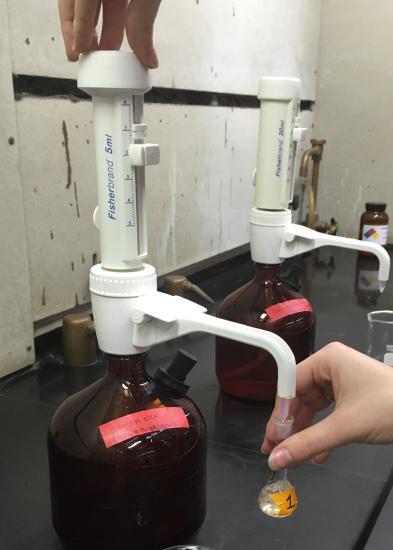 Using the dispenser, add the correct amount of \(\ce{KSCN}\) solution to each of the labeled flasks, according to the table below.
Step 4
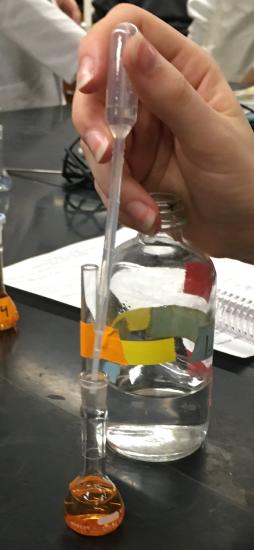 Fill the volumetric flasks to the line with \(\ce{HNO3}\). Mix each solution thoroughly by inverting the volumetric flasks several times.
Stride 5
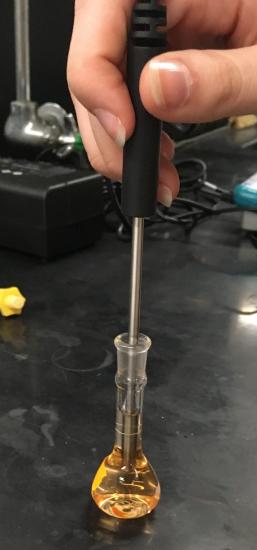 Take the temperature of 1 of the flasks using the Vernier Temperature Probe.
Table 2: Test Mixtures
| Mixture | \(\ce{Fe(NO3)iii}\) Solution | \(\ce{KSCN}\) Solution |
|---|---|---|
| 1 | 5.00 mL | 2.00 mL |
| ii | five.00 mL | 3.00 mL |
| 3 | 5.00 mL | four.00 mL |
| 4 | v.00 mL | 5.00 mL |
Five solutions volition exist prepared from two.00 x 10–3 Thousand \(\ce{KSCN}\) and 2.00 ten 10–3 One thousand \(\ce{Fe(NO3)iii}\) co-ordinate to this table. If the mixtures are prepared properly, the solutions will gradually become lighter in color from the beginning to the fifth mixture. Utilise this table to perform dilution calculations to find the initial reactant concentrations to use in Effigy three.
Part B: Grooming of a Standard Solution of \(\ce{FeSCN^{2+}}\)
Prepare a standard solution with a known concentration of \(\ce{FeSCN^{2+}}\).
Step 1
Label a sixth clean and dry ten mL volumetric flask as the standard.
Step two
Add together 1.00 mL of the \(\ce{KSCN}\) solution.
Footstep three
Fill up the remainder of the flask with 0.200 One thousand \(\ce{FeNO3}\). (Note the different concentration of this solution.) Mix the solution thoroughly by inverting the flask. This solution should be darker than any of the other v solutions prepared previously.
Office C: Spectrophotometric Determination of \([\ce{FeSCN^{2+}}]\)
Step 1
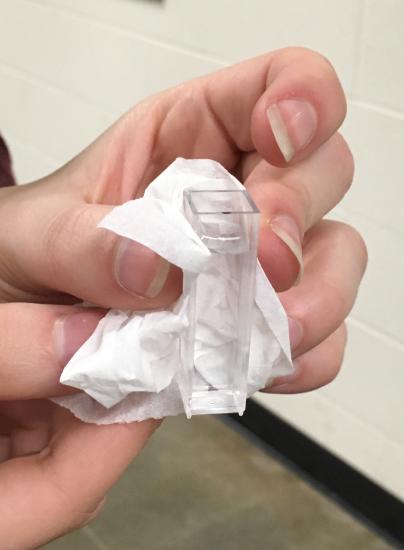 Make full a cuvet with distilled water and carefully wipe off the outside with a tissue.
Stride 2
Insert the cuvet into the Vernier colorimeter. Be sure to make sure it is oriented correctly past aligning the marker on cuvet towards the pointer inside the colorimeter and shut the lid.
Step 3
Select 470 nm every bit your wavelength past using the arrows on the colorimeter and press the calibrate button.
Step 4
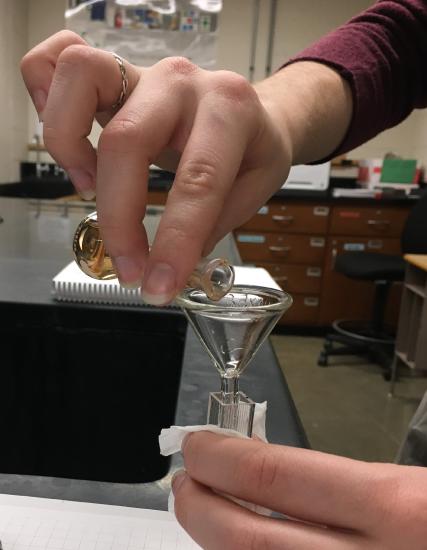 For each standard solution in Tabular array two, rinse your cuvet with a minor amount of the standard solution to be measured, disposing the rinse solution in a waste beaker.
Step 5
Fill the cuvet with the standard, insert the cuvet every bit before and record the absorbance reading. Go along until all solutions have an absorbance reading.
Step half dozen
Dispose of all solutions in the waste container.
Calculations:
Part A: Initial concentrations of \(\ce{Fe^{3+}}\) and \(\ce{SCN^{-}}\) in Unknown Mixtures
Experimental Data
| Volumetric Flask | Reagent Volumes (mL) | Initial Concentrations (M) | |||
|---|---|---|---|---|---|
| -- | 2.00 x 10⁻³ M \(\ce{Fe(NO3)iii}\) | 2.00 x 10-iii One thousand \(\ce{KSCN}\) | Water | \(\ce{Iron^{3+}_{i}}\) | \(\ce{SCN^{-}_{i}}\) |
| 1 | 5.00 | 5.00 | 0.00 | ||
| 2 | v.00 | 4.00 | i.00 | ||
| 3 | five.00 | 3.00 | 2.00 | ||
| 4 | v.00 | 2.00 | iii.00 | ||
| 5 | 5.00 | 1.00 | four.00 | ||
- Show a sample dilution adding for (\(\ce{Fe^{3+}})_{i}\) and (\(\ce{SCN^{-}})_{i}\) initial in flask #one.
The Standard \(\ce{FeSCN^{two+}}\) Solution
Given nine.00 mL of 0.200 M \(\ce{Fe(NO3)3}\) and one.00 mL of 0.00200 Grand \(\ce{KSCN}\), calculate the concentration of \([\ce{FeSCN^{2+}}]\).
- Equilibrium \([\ce{FeSCN^{2+}}]\) in Standard Solution: ______________ M
Note that since \([\ce{Fe^{3+}}]>>[\ce{SCN^{-}}]\) in the Standard Solution, the reaction is forced to completion, thus causing all the \(\ce{SCN^{-}}\) to convert to \(\ce{FeSCN^{2+}}\).
- Show the stoichiometry and dilution calculations used to obtain this value.
Exam mixtures
| Mixture | Absorbance | \([\ce{FeSCN^{2+}_{eq}}]\) (Yard) |
|---|---|---|
| 1 | ||
| 2 | ||
| 3 | ||
| 4 | ||
| five |
- Show a sample calculation for \([\ce{FeSCN^{two+}}]\) in mixture ane.
Assay
The reaction that is assumed to occur in this experiment is: \(\ce{Atomic number 26^{3+} (aq) + SCN^{-} (aq) <=> FeSCN^{ii+} (aq)} \)
- Write the equilibrium constant expression for the reaction.
- Show a sample adding for the value of \(K_{c}\) using the data for flask #1.
Using the same method you outlined above, complete the table for all the equilibrium concentrations and value of \(K_{c}\):
| Tube | Equilibrium Concentrations (Yard) | \(K_{c}\) | ||
|---|---|---|---|---|
| -- | \(\ce{Atomic number 26^{3+}_{eq}}\) | \(\ce{SCN^{-}_{eq}}\) | \(\ce{FeSCN^{2+}_{eq}}\) | -- |
| 1 | ||||
| 2 | ||||
| three | ||||
| 4 | ||||
- Boilerplate value of \(K_{c}\) ________________ (Use reasonable number of pregnant digits, based on the distribution of your \(K_{c}\) values.)
Source: https://chem.libretexts.org/Courses/Saint_Marys_College_Notre_Dame_IN/Chem_122L:_Principles_of_Chemistry_II_Laboratory_%28Under_Construction__%29/02:_Determination_of_an_Equilibrium_Constant
0 Response to "What Percent of the Scn âë†â€™ Present Initially Have Been Converted to Fescn2+ at Equilibrium"
Post a Comment